

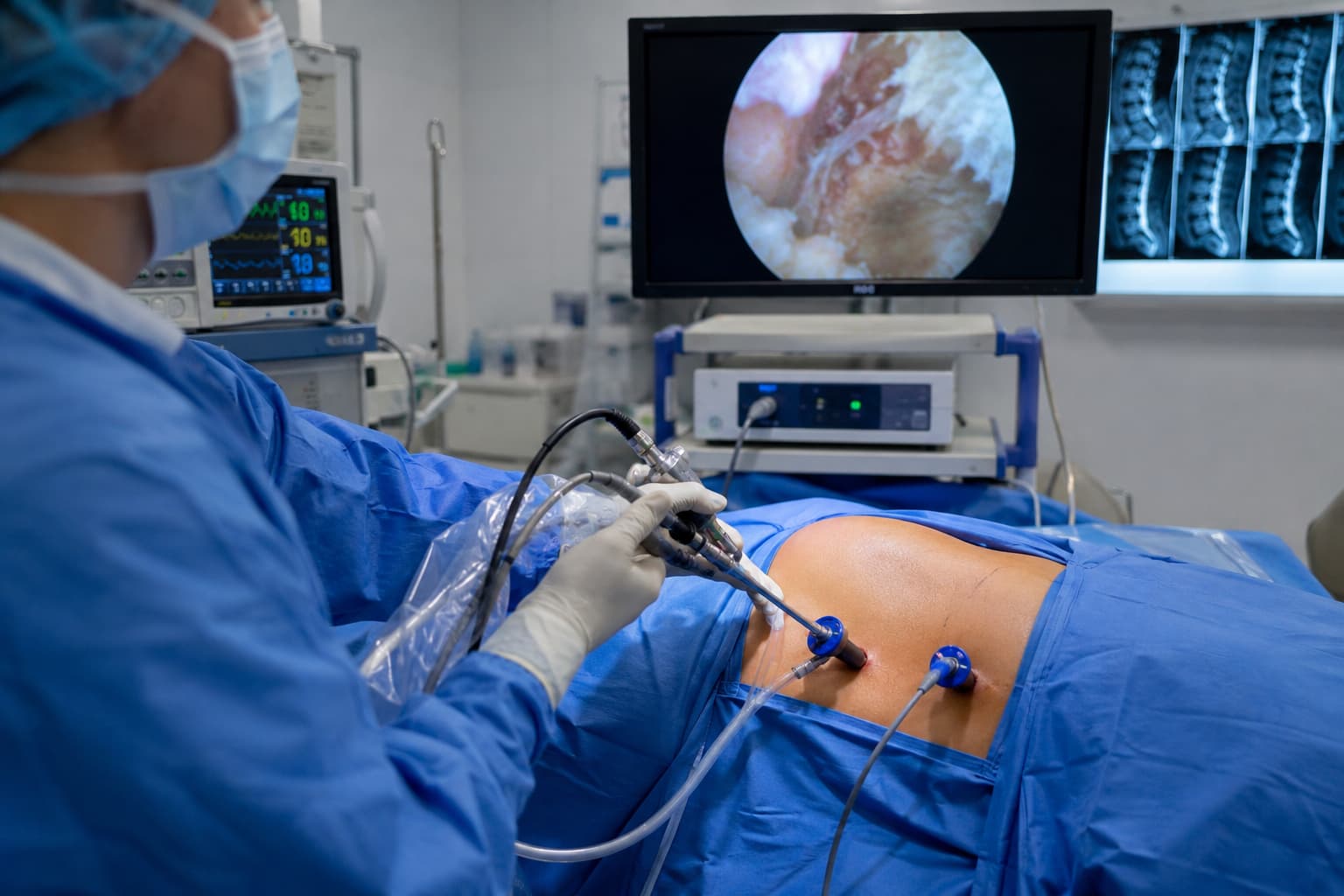
What Is UBE Spine Surgery — And Why Louisville Patients Are Choosing It
By Dr. Venu Vemuri, DO | Fellowship-Trained Spine Surgeon | miiSpine, Louisville, KY
If you've been researching minimally invasive spine surgery, you may have come across the term "UBE" and wondered what it means — and whether it's meaningfully different from other minimally invasive approaches or just another marketing term.
It's meaningfully different. Here's what UBE spine surgery is, who it's right for, and why I've integrated it into my practice at miiSpine in Louisville.
What Does UBE Stand For?
UBE stands for Unilateral Biportal Endoscopic surgery. Each word describes a key feature of the technique:
Unilateral — the surgeon works from one side of the spine.
Biportal — two small portals (entry points) are used. One for the camera, one for the surgical instruments.
Endoscopic — a small camera (endoscope) provides continuous visualization of the surgical field, irrigated with saline solution that keeps the view clear throughout the procedure.
Together, these features create an approach that gives the surgeon an exceptionally clear, magnified view of the spine through incisions that are measured in millimeters — not centimeters.
How Is UBE Different From Traditional Minimally Invasive Spine Surgery?
Traditional minimally invasive spine surgery (MIS) uses a tubular retractor — a hollow tube inserted through a small incision that holds the muscle aside and creates a working channel for the surgeon.
UBE is different in two important ways:
Two portals instead of one. By separating the camera from the instruments, the surgeon has greater freedom of movement. This is particularly valuable for procedures that require working across the midline or treating bilateral spinal stenosis through a single approach.
Continuous saline irrigation. The endoscope in UBE surgery operates in a fluid environment — saline continuously flows through the surgical field. This keeps the view crystal clear, controls minor bleeding, and reduces the heat generated by surgical tools.
What Conditions Can Be Treated With UBE Surgery?
UBE is primarily used for lumbar (lower back) spine conditions, including:
Lumbar disc herniation — when a disc bulges or ruptures and presses on a nerve root, causing leg pain, numbness, or weakness (sciatica). UBE allows precise removal of the herniated disc fragment with minimal disruption to surrounding tissue.
Lumbar spinal stenosis — narrowing of the spinal canal that compresses the nerves and causes leg cramping, pain with walking, or difficulty standing. UBE decompression can address stenosis at one or multiple levels through small incisions.
Foraminal stenosis — narrowing of the foramen through which nerve roots exit the spine. This is often the source of persistent leg or buttock pain that doesn't respond to injections.
Recurrent disc herniation — when a disc herniates again after a previous surgery. The UBE's superior visualization is particularly valuable in these revision cases.
What Are the Advantages of UBE Over Traditional MIS?
Less muscle damage. The two small portals cause minimal disruption to the paraspinal muscles. Less muscle damage means less post-operative pain and faster functional recovery.
Better visualization. The endoscopic view in UBE surgery is magnified, illuminated, and continuously clear.
Faster recovery. Most UBE patients experience significantly less post-operative pain than traditional surgery patients. Many return to light activity within one to two weeks — similar to outpatient spine surgery recovery timelines.
Outpatient eligible. UBE procedures are routinely performed as outpatient procedures. Patients go home the same day.
Is UBE Surgery New? Is It Proven?
UBE has been performed internationally — particularly in South Korea and Japan — for over a decade, with a substantial body of peer-reviewed literature supporting its safety and efficacy.
In the Louisville area, very few surgeons currently perform UBE surgery. This means patients who want this approach have limited options locally — which is part of why I made the investment to learn and integrate UBE into my practice at miiSpine.
Am I a Candidate for UBE Surgery?
The best way to find out is a consultation. Generally speaking, UBE is worth discussing if you have:
- Lumbar disc herniation causing leg pain or weakness
- Lumbar spinal stenosis causing leg cramping or difficulty walking
- Foraminal stenosis causing persistent nerve pain
- A prior spine surgery with recurrent symptoms
- Been told you need spine surgery and want to explore the most minimally invasive options
UBE is not appropriate for all spine conditions. Complex instability or multi-level fusion requirements may be better addressed with lumbar fusion or other approaches. I'll give you an honest assessment at consultation.
Not sure if surgery is even indicated? Consider a spine surgery second opinion first.
UBE Surgery at miiSpine in Louisville
miiSpine is one of the few practices in the Louisville, KY area offering UBE spine surgery. If you're researching your options or have been told you need spine surgery, I'd encourage you to come in for a consultation before making a decision.
Call (502) 242-6370 or visit nobsspineconsult.com for an online second opinion from anywhere in the country.
Dr. Venu Vemuri, DO is a fellowship-trained, board-certified spine surgeon and founder of miiSpine in Louisville, KY. He trained at Norton Leatherman Spine Center and specializes in minimally invasive and endoscopic spine surgery including UBE.
miiSpine | 6420 Dutchmans Pkwy, Suite 160, Louisville, KY 40205 | (502) 242-6370 | miispine.com


